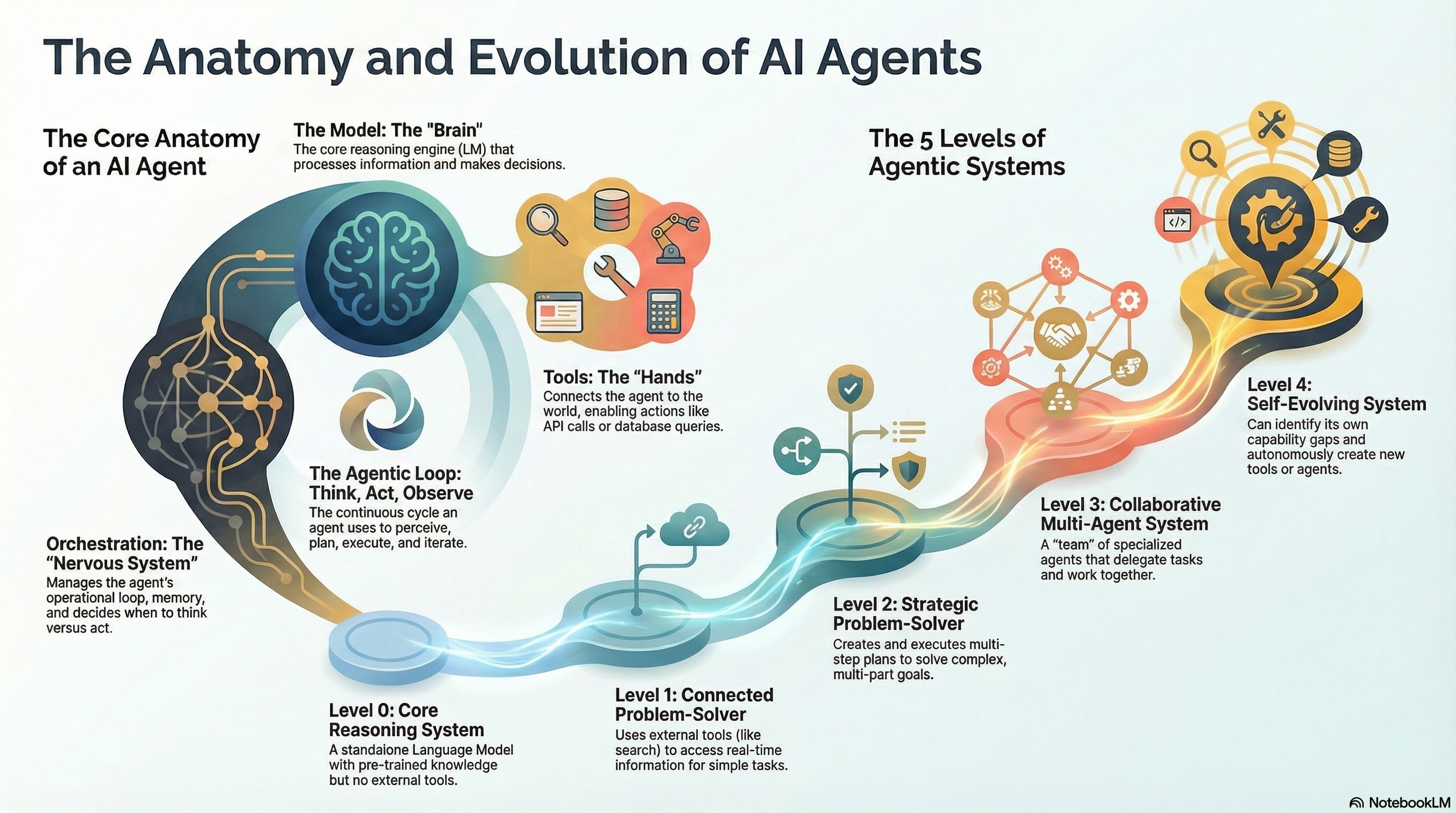
The 5 Levels of Agentic Systems

Exploring the evolution of AI agents
The evolution of AI agents is a fascinating journey that parallels advancements in technology and our understanding of artificial intelligence. Let’s delve into how AI agents have developed over time and their core components.
The core anatomy of an AI agent
- The Model: The "Brain"
The reasoning engine processes information and makes decisions. - The Agentic Loop: Think, Act, Observe
A continuous cycle used by agents to perceive, plan, and execute actions. - Orchestration: The "Nervous System"
Manages the agent’s operational loop and decides when to think versus act. - Tools: The "Hands"
Connects the agent to the world, enabling actions like API calls or database queries.
The 5 levels of agentic systems
- Level 0: Core Reasoning System
A standalone language model with pre-trained knowledge but no external tools. - Level 1: Connected Problem-Solver
Uses external tools to access real-time information for simple tasks. - Level 2: Strategic Problem-Solver
Creates and executes plans to solve complex, multi-part goals. - Level 3: Collaborative Multi-Agent System
A team of specialized agents that delegate tasks and work together. - Level 4: Self-Evolving System
Capable of identifying capability gaps and autonomously creating new tools.
These components and levels illustrate the dynamic and expanding capabilities of AI systems, underscoring their potential across various domains.
For more insights into integrating AI themes into your book, explore additional resources on our website.
If you have any specific questions or need more guidance, feel free to reach out!